
Different upstream and downstream conditions
Customers and suppliers use different protocols, accounts and status formats.
Messaging service providers
Use Web, SMPP, HTTP and API for upstream and downstream access, with queue scheduling, retries and channel protection for high-volume operations.

Provider priorities
Service providers must coordinate customer access, channel resources, traffic peaks and exception recovery in one controllable operating path.
Customers and suppliers use different protocols, accounts and status formats.
Large simultaneous submissions require queues and scheduling to preserve processing order.
Repeated failures or content issues can increase operating risk without timely controls.
Connect different systems and roles through SMPP, HTTP, API and Web.
Use tasks and queues to absorb peaks and follow processing progress.
Apply retries, channel sleep, content replacement and keyword controls.
Recommended capability set
Track customer submissions, platform scheduling and supplier results from connection through returned status.
Configure connections, accounts and submission methods for each partner.
Testing has reached 10,000-level concurrency and more than 100 million messages in a day.
Manage queue order, processing progress and high-volume task state.
Reprocess failed work according to configured policies.
Pause repeatedly failing channels to contain operational impact.
Use replacement, keyword blocking and multi-dimensional reports.
Provider operating workflow
Bring connection validation, queue scheduling, channel routing and result records into one operating flow.
Enterprise or reseller customers submit through SMPP, HTTP, API or Web.
Account, balance, content and task rules are checked before processing.
Messages are submitted according to destination and supplier configuration.
Record returned states and apply retries, sleep policies and operating follow-up.
Product interface
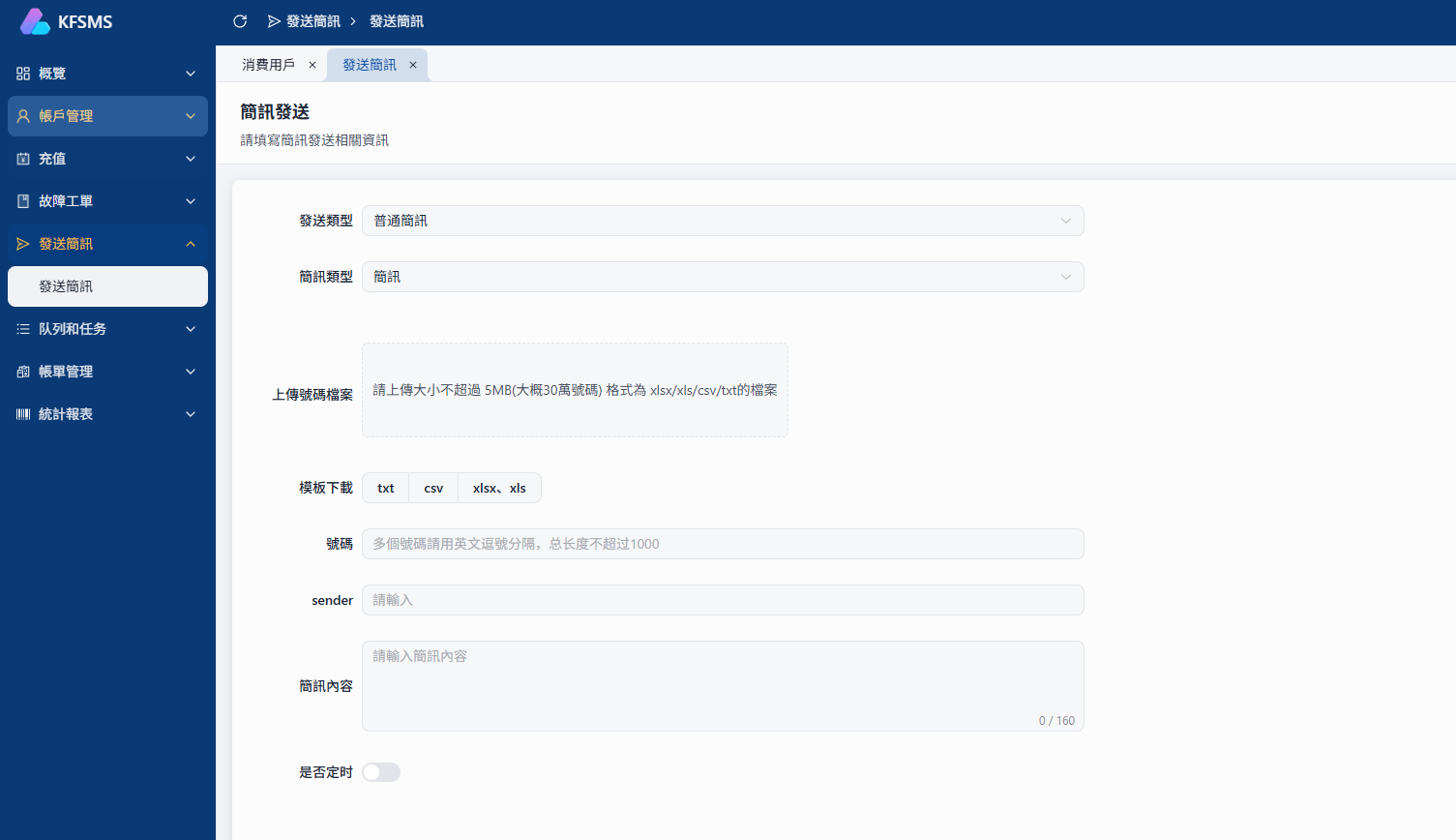
Build recipient lists, content and schedules, then track actual processing through tasks and queues.
Infrastructure guidance
A dedicated physical server and fixed outbound IP can be deployed, hosted and maintained with KFSMS support.
View dedicated deploymentCustomer-owned hardware that is not shared with other customers.
Configure a dedicated address and adjust it when network requirements change.
Raise technical issues around the clock for assessment and troubleshooting.
FAQ
Share protocol requirements, target markets, expected concurrency and channel resources so we can explain the platform architecture and delivery model.